


Reflection#
Lately, I have been reflecting on the impact of “Artificial Intelligence” in all the spheres of my life: personal, work, cultural. The short-term impact of AI has been a net… good? Hard to have a definitive opinion.
However, I still worry about the long-term impact of AI. I do think that I have broader apprehension of the impact of AI for my future and my children’s future.
THE GOOD#
— 伪中国谚语
Assume artificial intelligence is used responsibly™ here.
Here are some examples where AI has made a positive impact presuming careful attention to detail has been applied to the problem we are solving with AI:
Learning
This may or may not be controversial to the haters: AI is really good at teaching. Teaching you the correct things (mostly), but, also potentially incorrect things. Here’s what’s nice about the current state of LLMs: they can’t have motive. LLMs can have bias; more on that later. But, it’s important to understand that it’s just statistics, which can’t have an emotional connection to motive. There can be motive behind the development of a model, but, unless there’s some real nefarious actors behind the scenes, it is mostly just maths. You need healthy skepticism to question the responses/answers it will give you. But, with enough curiosity and some time on your hands, you can learn new concepts in domains you would not have ventured into otherwise. It’s like having a library of knowledge accessible at your fingertips, but, if you ask the librarian for too much they may go off on ancillary tasks that reduce the focus and core of your research. AI loves busy work. In my experience, when I need an explicit task done, I have needed to ensure my prose and questions are direct to ensure the LLM does not wander off. It is, after all, in your statistical best interest.
Bias
The advent of the internet was a terrifyingly wonderful thing. Give me a moment to set the stage because the scene got really ugly and I need to convey this point with emphasis. I recall in the 90’s poking around and being amazed at discovery of really cool, niche, and esoteric websites that were purpose built for a small group of people. Back then, dialog was focused in small circles. Islands of cliques where you had a sense of belonging and had ownership of participation. The instant access to vast amounts of information so instantaneously with so little regard to security was really quite astonishing. Then, the money came in fast in the mid to late 90’s. It inflated the market quickly creating a huge bubble1. The dotcom bubble popped and it put off the greed glands for a while. But, the advent of the iPhone/Android brought the money back in and since then it has wreaked havoc2, divided us socially 3, and generally just decimated4 the social fabric5.
I think it’s pretty safe to assume the causation is terminally online young people with access to smartphones. To make matters worse, our representatives at the state and federal level (here in the United States), have functional technological incompetence6.
Let’s reel this back in and focus on the social division explicitly. More and more people are beginning to ask AI for gazpacho recipes and whether they should walk to the car wash. There’s evidence to suggest that AI is debiasing decision making7. This can be a great thing in the polarized online world in which we interact. Even Elon Musk’s MechaHitler8 has become less biased9 lately. That’s not to say the trust is back. Any person with as much wealth and resources will likely always figure out how to influence the product they own.
Still, there’s a quiet hope buried in here. A tool with no tribe, no ego, and no axe to grind can be a counterweight to the outrage machine we spent the last two decades building. Where the algorithms of the 2010’s profited by pulling us apart, a model that just weighs the evidence can, I hope, nudge us back toward a shared set of facts. It might be the first internet-scale tech in a long while with a real shot at reducing the division instead of monetizing it. 🤞
Expediency
From my personal perspective and professional experience, the overall experience using AI tools has been a net positive. It has enabled faster bug fix or feature delivery in a pragmatic fashion, expanded our testing into areas we otherwise would not have ventured, and empowered developers to build a better experience tailored to their needs (e.g. entire git worktree helper workflows that I heavily utilize across tmux sessions). Completing small one-off tasks in quick fashion becomes pretty handy. I find this to be the most compelling use of AI.
Utility
I find myself using Claude to experiment in languages and playing around in domains I would not have otherwise attempted to play with in rarely available free time.
💡 Want to build a fancy static website?
Yea, I have for a long time, but, I still wanted something custom and tailored to my tastes. Somewhere to put my thoughts and not somewhere where I spent my free time debugging.
💡 Want to build a custom high-performance WASM graphing library using Rust inspired by elm charts?
Indeed. I’ve not open sourced any of that work, but, I did find a niche maybe worth exploring later.
💡 Want to build a small videogame in Bevy?
Sure. I would definitely not be playing with Bevy otherwise. I have a few ideas that could probably be expanded on, but, I just wanted to see what the process was like.
I find myself having fun with AI because it raises a different joy, internally, that I feel like only product managers get when the completion of a feature rolls out.
“We did it guys! We got it out.”
* high fives all around *
Documentation
It’s never been easier to maintain documentation within your projects.
Utilize <LLM_of_your_choosing> to create documentation for users to parse with ease.
But, it is very easy for the model to create documentation that is verbose.
It is better to have effective communication over detailed communication.
Brevity is your friend here. There’s a reason the U.S. military has Brevity Codes.
You may not need Brevity Codes, but there is a reason for their existence.
There is only so much cognitive load people can handle and it varies per human.
Scope
As a software engineer, scope management can really help prioritize and communicate better delivery expectations to product managers and stakeholders.
Ever needed some assistant scoping a project or feature? Cut the noise and remove any bikeshedding?
Refine scope with dear Claudius (or <LLM_of_your_choosing>) and let the team agree/disagree with the proposal.
The objective doesn’t change from before: you still want to push digestible content (PRs).
Admittedly, I’m still working on this skill too.
Dotfile Management
As an engineer, I am constantly refining my dotfiles. Using tools like Claude help make changes so quick that my process/workflow incremental changes are now a breeze.
Automation
There is a book called Automate the Boring Stuff with Python. I think LLMs have introduced a small superpower that I don’t think gets enough love ❤️. There are dozens of hidden opportunities that you can easily automate with the assistance of an AI. The idea here is anything that never gets prioritized in your day because
A) you don’t have the time,
B) don’t want to prioritize it because it will take a chunk of your day that you could lose, but decided to read Hacker News instead, or
C) tasks so genuinely boring you would never have allocated time otherwise.
This can manifest in some of the following ways:
- Generating a report you have been putting off for months
- Generate email template(s)
- Dump aggregated db data into an excel spreadsheet for analysis later
- Batch rename, reorganize, or de-duplicate that download folder you have been ignoring
- Convert and clean data between formats (CSV → JSON, scanned PDF → searchable text)
- Scrape a changelog or RSS feed and summarize what actually changed
- Stand up a tiny cron job that pings you only when a number crosses a threshold
- Turn a wall of meeting notes into action items and a follow-up email
THE BAD#
— 伪中国谚语
Assume artificial intelligence is sometimes used responsibly™ here.
Vibes
VibecodingLet me make it explicitly clear: I’m perfectly fine with Vibecoding. But, in 2026, probably best to keep huge one-shot prompt software out of production. Letting Claude (or especially Copilot 🤮) loose to build complex software in isolation that you depend on is just irresponsible™.
Rapid Evolution
AI’s rapid feature evolution has wrought process obsolescence. The tech is changing so quickly that processes become antiquated over weeks and months and not years. It’s becoming increasingly harder to keep up with how we are supposed to interact with these systems. This surfaces itself during our re-evaluation of the AI tools we are using in the workplace. Maybe we change the frequency at which we do that, but, how frequently does one need to evaluate HOW to use the tools the TEAM is using? It seems capricious to constantly be thinking about HOW to use AI on a regular basis. Are there diminishing returns on investing time to refine processes?
Another frustration I have is that there really is not a way to take a high quality LLM offline. It takes a lot of energy, memory, and storage space to utilize this technology locally. Costs for access to this hardware have exploded. How can the average person afford this tech locally? They can’t. It’s almost as if the intent is to force you to use the cloud to utilize these tools and there’s so little focus on optimization because the intent is to charge you huge sums for enterprise access. These private companies essentially want to Microsoft this software.
Thinking Critically
Long term, my suspicions are that it will likely further separate those who will not or cannot critically think about systems and problems. There will be jobs for the “good enough” cohort of people, so that they can move along with their lives. Which is fair, not everyone has a desire for the engineering part, but, is it fair to the employed who do have that deep curiosity to build?
Illusion of Understanding
When AI hands you a working answer, you feel like you understand it, but you’ve skipped the struggle that develops real intuition, innate understanding of how systems work, and debugging skills. AI lets you consume solutions fast, but speed of intake isn’t the same as depth of understanding. How will this affect junior devs today?
Children’s Future
The full impact of LLM usage on young users has yet to materialize. My opinion is their bias won’t be impacted; it will be their educational curiosity. How do we keep the desire to learn when the effort to do a lot of the research has been diminished? Is it not true that the benefits and payoffs of education are rooted in the effort put forth by the student? The logic follows: take away the effort and you take away the payoff. When the model handles the questioning, the problem solving, and the thinking, there’s nothing left to actually learn from. I posit that education leaders should lean into exposure to more critical thinking.
I speculate that there is, currently, a socioeconomic shift occurring and it may not even be noticeable yet. Are kids in poverty going to gain access to AI tooling to enable true knowledge gain in good faith? I was not raised in poverty, so, I can only speculate. But, I imagine upward socioeconomic mobility will become increasingly harder if the pockets of society that need that subsidization for access don’t get it. Maybe the ratio doesn’t change at all. After all, there are plenty of examples of leaders in culture, business, and politics who perpetually failed upwards.
My real question stems from overall long-term impact. What happens to a generation raised on reliance? Do they all become Spock or do they become greeters at Costco?
“Welcome to Costco. I love you.”
Have LLMs Peaked?
Enough about what AI is doing to us. There’s a separate question worth asking about the technology itself.
There is a book entitled The Algebraic Mind 10 (MIT Press, 2001) which argues that real cognition requires symbolic manipulation, not just statistical pattern completion. Makes sense; that’s all LLMs do. Put simply for any non-technical folk reading this, LLMs are statistics. The author, Gary F. Marcus, argued in late 2024 that LLMs reached a point of diminishing returns 11. This might be true since training costs and inference costs have only ballooned. Hard to get real numbers on this since most of the companies are private and the only company to file publicly with numbers in the open is SpaceX12. But, it would appear that inference usage is not going down like originally promised and more recently reiterated13 by OpenAI’s CEO Sam Altman in January. I’m beginning to think all the drivel CEO-speak that exits his mouth is lie after lie.
THE UGLY#
— 伪中国谚语
Assume artificial intelligence is never used responsibly™ here.
Techno-feudalism
If you are unfamiliar with Technofeudalism14, there’s a whole book15 you can read on the topic, but the gist from the wikipedia page:
Technofeudalism is a term used to describe a modern economic system where big technology companies have power similar to feudal lords in the past. Instead of land, these companies control digital platforms, data, and online markets. People and smaller businesses rely on these platforms, just like peasants once relied on feudal lords for land and protection.
In essence, becoming part of the “capital class” is becoming increasingly out of reach for the citizens who labor. What happens when the cloud, models, and APIs - the new “land” - extract a toll we never stop paying? Will we always be reliant on paying for access to frontier models?
In a capitalist society, a small group of entrepreneurs could kick start their own new technology out of their garage. It was how Google was built. It was how Apple was started. We have seemingly transitioned into an economy where only massive amounts of private equity get to dictate what new amazing technology gets put into the world. Would starting from scratch to train an LLM out of a garage have been expensive? Who knows? I can imagine a world where LLMs are better and more efficient because they started out of someone’s garage mainly due to the financial constraints. Sure, it would have taken longer, but the cultivation of wealth would have coalesced around those with the ideas not the ones with access to money. I fear this may become more true with future technologies: we will just rent services for the rest of our lives because we (the laborers) won’t have the capital to compete. Should this trend continue, I can see how this is another argument towards the Technofeudal future that may await us.
Skill Atrophy
Engineers losing hands-on skill when they move into management is a familiar story. You trade one set of experience for another; fewer commits, more meetings, more 1:1s. It’s a conscious and responsibility swap. This is morally acceptable.
AI atrophy is different. You’re still officially an engineer. The title hasn’t changed. The work, on paper, hasn’t changed. But the muscle you’re actually using has shifted from “build a mental model and reason through it” to “describe the shape of the thing and accept what comes back.” That’s not a trade. There’s no compensating skill you’re picking up that’s of equivalent depth. You’re just doing less of the thing. This can be dangerous.
I got into this for love of programming. Through the struggle of learning how systems worked, we built a whole skillset to solve problems. The struggle was the joy. But, also the autonomy of being able to do the thing adds to that joy. The open question I sit with: is what’s atrophying reversible? Could I get it back if I needed to? I genuinely don’t know, yet. I still do some things manually to flex these muscles, so that they hopefully stay loose.
Quota Hike
Because you can produce more doesn’t necessarily mean you should produce more. More ≠ better. Producing and documenting the code used to be a labor-intensive task. Anecdotally, I have friends who are telling stories of other teams in their organizations having token competitions. That’s hearsay, but, it’s also pretentious and toxic. This is akin to letting a LinkedIn thread dictate how your sprint should go. If your objective is long-term harm and burnout galore, congratulations, this is the path you and your total lapse in competent leadership will take you. Bravo!
Instead, organizations should let their employees use the time they get back to build upon their curiosity. How do you think they got there in the first place? Let them read material or practice concepts outside their comfort zone. Let them expand their realm of expertise because it does not just benefit them personally, it benefits your enterprise. Let your employees have kaizen (改善) time.
Economic Impact
At the time of writing (June 2026), there are economic indicators that one might deduce broader issues within the U.S. economic system. But, let us focus on the vibes of early summer 2026. If the objective is to increase hate for artificial intelligence, the media is doing an excellent job. There is article after article about layoffs16 and dread.
You would think if big tech wanted the populace to reverse-glaze AI, they would be spending substantial amounts of capital for emotional marketing. Instead, they are having to spend CapEx on hugely expensive line-items like training the next model and environmentally toxic data centers17. My assumption is there is zero financial bandwidth to allocate additional funding to marketing campaigns for consumer sentiment. Instead, it appears that they have to target consumer wallets. I digress.
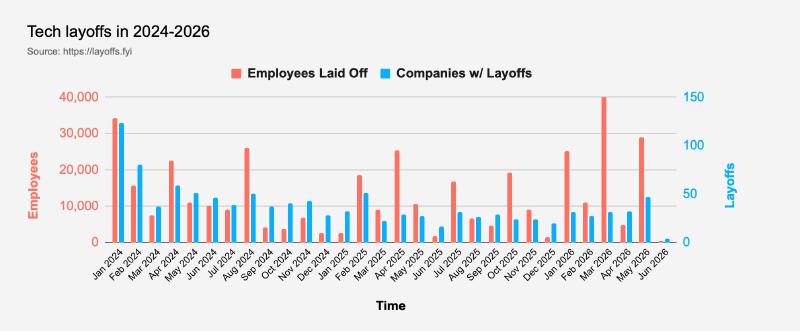
But, correlation does not imply causation. The FED reported in March 2026 that we were in a “low hire low fire” 18 economy. However, a month later, they released another article stating that, while unemployment remained steady, job separation was on the rise 19.
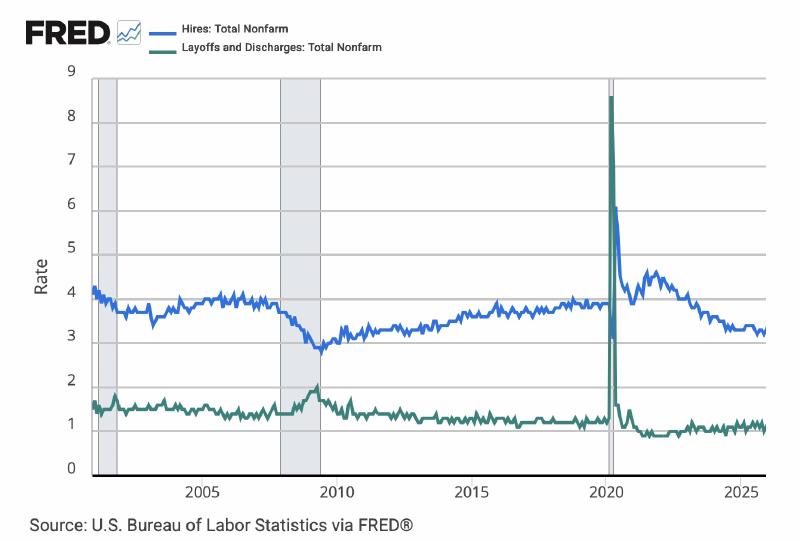
If this trend continues, will there be a rise in unemployment? Who’s to say? I am not a financial advisor.
Online Social Contract Breakdown
If you were to sit on the other side of the table of an actual human, I doubt you would have that many major disagreements. There might be some minor variations on solutions, but the overall objective would be the same: how do we cultivate the society we want to live within. Online, however, we are totally different animals. Anonymity is absolutely a good thing online. It is also absolutely a terrible thing. Our behavior online post-Boomers-finding-Facebook is pretty reprehensible. There exists a huge lack of appreciation for what you can achieve with the internet. Look at what Google did. Google made internet search and access to the world’s knowledge accessible to the extreme and, statistically, all we do online is bicker, watch YouTube Ads, and doomscroll20. Sure, there is a ton of useful and happy content online, but, you really need to be cognizant and constantly reminding yourself of the type of experience you want online. This is why I think there has been a rise of “AI dating”. People are seeking escape from their social circles (online or in real life).
Will AI entrench us further in this dystopic online culture; this downward spiral of vapid lifestyles? Will reclusive introverts only speak to their AI counterparts and be semi-permanently hooked into VR headsets?
False Premises
No, you read that right: premises not promises. We all want AI to make our lives better: utopic not dystopic. We would prefer our AI to be Rosie from the Jetsons. We want/need it to fold our laundry, do the dishes, and let the dog out to poop 💩. We want it to make our lives materially easier. Instead, it’s making Mario Kart Police Chase videos.
Sigh
Conclusion#
I won’t pretend to know what the future holds in regard to the direction of all this. The apprehension I opened with for our collective future hasn’t gone anywhere. Instead, I am consciously choosing to hold it alongside the excitement. Stay pragmatic and grounded in reality. I do know it’s invigorated an excitement in software I haven’t had for some time. In the software world, what’s coming, I think, will be pretty cool. There are huge swathes of people that have been gated because the barrier to entry was so high in the industry. It’s been lowered a little bit. We just need to wait for the people who have been sitting outside that circle to be inspired to create. 🙂
Are you that person?
Fueling The Fire: How Social Media Intensifies U.S. Political Polarization – And What Can Be Done About It ↩︎
Why Gen Z is Forgetting How to Talk to People: Headphones, Phones, and the Decline of Social Skills ↩︎
Legislation, loopholes, and loose ends — what does 2026 hold for the VPN industry? ↩︎
Artificial Intelligence Can’t Be Charmed: The Effects of Impartiality on Laypeople’s Algorithmic Preferences ↩︎
Elon Musk’s AI chatbot, Grok, started calling itself ‘MechaHitler’ ↩︎
Sam Altman Just Dropped 8 Hard Truths About the Future of AI ↩︎